
HKCO
Hong Kong Chinese Orchestra Environmental, Social and Governance Artistic Director and Principal Conductor for Life Orchestra Members Council Advisors & Artistic Advisors Council Members Management Team Vacancy Contact Us (Tel: 3185 1600)
Concerts
Education
The HKCO Orchestral Academy Hong Kong Youth Zheng Ensemble Hong Kong Young Chinese Orchestra Music Courses Chinese Music Conducting 賽馬會中國音樂教育及推廣計劃 Chinese Music Talent Training Scheme HKJC Chinese Music 360 The International Drum Graded Exam
Instrument R&D
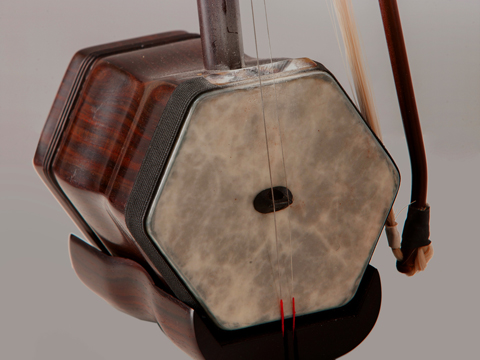
Eco-Huqins Chinese Instruments Standard Orchestra Instrument Range Chart and Page Format of the Full Score Configuration of the Orchestra
04
May 2012
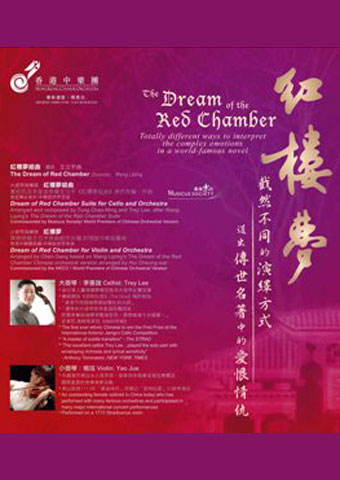
The Dream of the Red Chamber
Totally different ways to interpret the complex emotions in a world-famous novel
Date and Time
4-5/5/2012
8:00pm
8:00pm
Venue
Hong Kong City Hall Concert Hall
Ticket Fee
$300, $250, $150
Conductor
Yan Huichang
Performed by
Yao Jue / Trey Lee
Videos
Programme
The Dream of Red Chamber Suite (Excerpts) Wang Liping

The Dream of Red Chamber Suite for Cello and Orchestra
Arranged and composed by Tung Chao-Ming and Trey Lee,after Wang Liping's The Dream of the Red Chamber Suite
(Commissioned by Musicus Society/ World Premiere of Chinese Orchestral Version)
Cello: Trey Lee
- The First ever ethnic Chinese to win the First Prize at the International Antonio Janigro Cello Competition
- "A master of subtle transition" - THE STRAD
- "The excellent cellist Trey Lee..played the solo part with enveloping richness and lyrical sensitivity - Anthony Tommasini, NEW YORK TIMES
The Dream of the Red Chamber for Violin and Orchestra
Arranged by Chen Gang based on Wang Liping's The Dream of the Red Chamber Suite Chinese orchestral version arranged by Hui Cheung-wai
(Commissioned by the HKCO/World Premiere of Chinese Orchestral Version)
Volin: Yao Jue
- An outstanding female violinist in China today who has performed with many famous orchestras and paricipated in many major international concert performances
- Performed on a 1713 Stradivarius violin
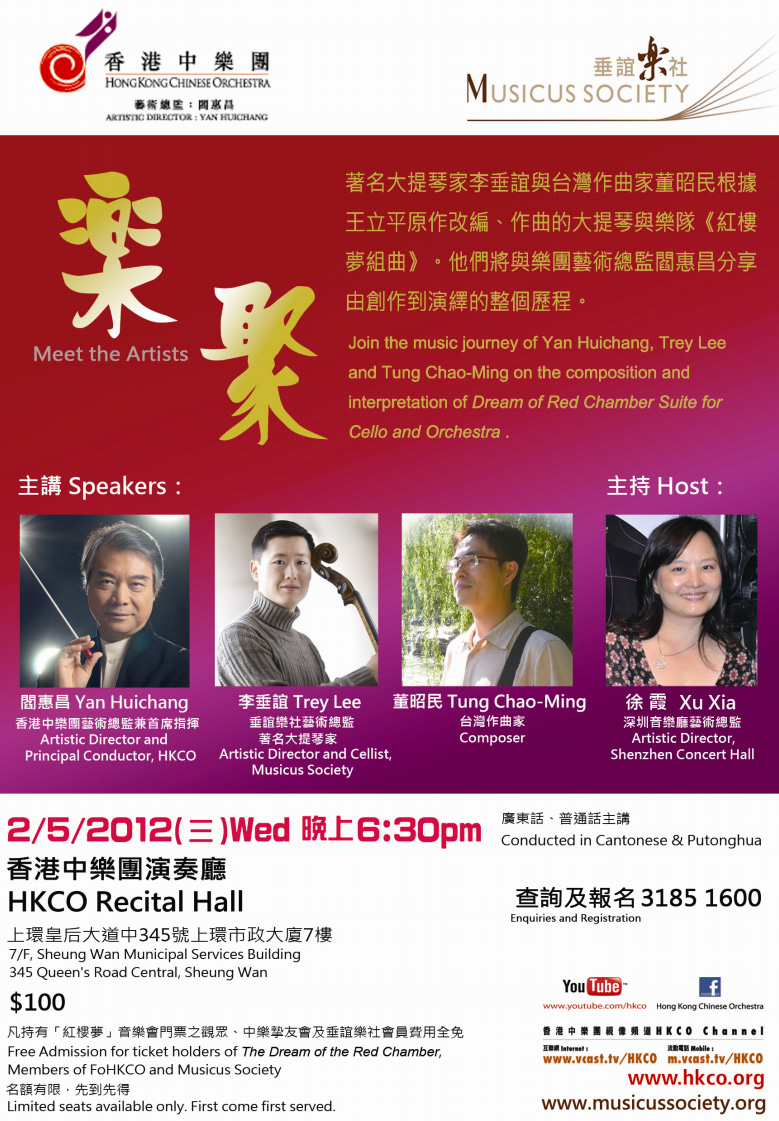
Meet the Artists: Yan Huichang, Trey Lee, Tung Chao-Ming
Music: Views and Previews
The arrangement and re-arrangement of musical works
Chow Fan-fuThis is a very special and interesting concert, and inspirational, too, because it features arrangements and re-arrangements of musical works.
It does not seem difficult to define an original composition and an arrangement of an existing work, but there is a lot of controversy involved in whether the arranger should be entitled to copyright. And, it is hard to define what an arrangement is. For example, to have a piece for the erhu performed on another instrument may involve different changes to the original depending on which instrument(s) the arranged work is to be played. If the work is to be set for orchestral performance, then it will involve a lot more work, and enter the realm of “orchestration”. From this we can see that an arrangement may involve varying degrees of “intelligent artifice”. While some works can be applied to another instrument without any alteration, there are also some which are easier to compose than to arrange.
There are two major pieces in this concert. The first is The Dream of the Red Chamber Suite for Cello and Orchestra arranged by Tung Chao-Ming and Trey Lee. This is, as described on the programme, “arranged and composed by Tung Chao-Ming and Trey Lee, after Wang Liping's The Dream of the Red Chamber Suite.” This means that apart from “arranging” the work, the two named musicians have also put in fresh compositional materials. The second piece is an “arrangement” by Hui Cheung-wai, The Dream of the Red Chamber for Violin and Orchestra, in which the solo part will be played by violinist Yao Jue. Hui’s arrangement is based on a piece for violin and western philharmonic orchestra “arranged from the work of the same title by Wang Liping, with original materials added, by Chen Gang.” This amounts to saying that this is a piece that is a “re-arrangement”, being derived from an arrangement, by Chen Gang, of an original work by Wang Liping.
According to Hui Cheung-wai, this “re-arranged” work involves, in a way, a lot more “intelligent artifice” than composing a piece afresh. It is Hui’s opinion that the version arranged by Chen Gang for violin and western orchestra demonstrates a much more mature and enriched exploitation of the performance techniques of the violinist, much more than can be seen in the immensely popular Butterfly Lovers Violin Concerto which Chen co-authored with He Zhanhao. For this reason, Hui has not made much alteration to the violin part of the Chen version, but converting the score for western orchestra for performance by a Chinese orchestra involves a lot more than merely replacing the instruments. The Chinese orchestra features plucked and strummed instruments which are not found in the western orchestra. It also has its own set of unique percussion instruments. On top of this the score for the solo violin has remained in principle unchanged, and so a lot needs to be done in the way of orchestration in order to accommodate and complement the solo instrument.
At the same time, Hui feels that The Dream of the Red Chamber is a literary classic, and he deems it appropriate for melodic fragments from the ancient guqin tune, The Song of Yangguan, to be incorporated in order to highlight the work’s air of classical literary elegance. We can deduce from all the above that this “re-arrangement” not only requires the musician to provide the instrumentation for a Chinese orchestra within the framework prescribed by the violin as the solo instrument, but also necessitate the blending in of bits and pieces from an ancient tune. The intelligent artifice that the re-arranger applies to such a work is certainly no less than what is required of him from an original work composed afresh.
To be honest, the original The Dream of the Red Chamber by Wang Liping is incidental music for a television drama series, and as such is a functional type of music. After the work has been adapted for the concert stage, the listener can still discern in it the theme of Seeds of the Rosary Pea, a famous art song by Liu Xue’an, one of the “true exponents” of Huang Zi and who was active in the 1930’s and 1940’s. However, the original work of Wang Liping will in no way be regarded as an arrangement of the Seeds of the Rosary Pea, the reason being that the art song plays only an insignificant part in the entirety of Wong’s work.
So, the interesting question is, quantitatively speaking, to what extent should the original music be retained in the new work, and what proportion should it bear vis-à-vis the new materials, if a work is to be cited as an “arrangement”? And, for the present concert, how much of what we hear comes from the work of “arrangement”, and how much is “original composition”? Or are the works to be more properly labelled “arrangement with originally composed music”? This has to be decided by the audience themselves after listening to the performance, and I am sure this dimension will add to the interest of the concert itself.