The charm of African drum music
Chow Fan Fu
Whatever the racial or ethnic background, drum music in various parts of the world mostly originated from the need for communication. Then, as drum music developed and became more complicated, such a function gradually diminished. Yet drums still form an important part of percussion music to this day. The drum music of the African continent has also exuded much charm and attraction as a unique sub-culture within the musical world.
African drums - the spirit of traditional African music
Before the Second World War, Africa was a land of colonial enclaves of the European powers. Under the protection of their political muscles and powerful artillery, Western culture became the dominant cultural force on this vast and expansive land, referred to by the West as the “Dark Continent”. Despite their infiltration, the indigenous culture, regarded by the West as ‘backward’, thrived on with tenacity among the tribes. When the Second World War came to an end, the colonies began their long road to independence. The culture of each race or tribe also began to show its uniqueness and vitality, and this was nowhere more obvious than in the indigenous music of the various tribes, in which the spirit of the people would reside. During the post-colonial era in the 1960’s and 1970’s, when most African colonies had become independent nations, traditional African music began to appear at increased frequency on the world music stage. African music, or to be more precise, ‘African drum music’, also began its long and deep influence on musical cultures all over the world, particularly so in popular music.
The vast geographical spread of Africa led to great racial and linguistic diversity. The music of the Africans may be different from nation to nation, but there is one instrument common to all, and it is the drums. Rhythm, the essential characteristic of drum music, is fundamental and most important to the music of all tribes. In places south of the Sahara Desert, drum music is synonymous with the music of all the tribes. For this reason, the African drum is also known as the soul of indigenous African music.
Having said that, one must know that ‘African drum’ is only a generic term. In the past few decades and according to statistics rather haphazardly compiled, the basic drum-forms identifiable among the various tribes total a few dozen. The drums come in hundreds of different shapes and sizes. In West Africa alone, there are over a hundred different rhythmic patterns in the drum music there. The largest are as big as a water vat, and the smallest the size of a sherry glass. These drums are covered with not only the more commonly encountered ox and antelope hides, but also the skins of zebras, deer, leopards, and rare types such as lizard and crocodile skins. There are cases in which they are covered with the skin from the ears of an elephant!
As said, African drums come in all shapes and sizes, and the shape of the drum is an important symbol of the culture of the tribe concerned. The drums are usually decorated with various patterns and pictures, and these form an important demonstrable part of the culture they represent. In addition to such diversities, the way the drum is carried by the player also varies tremendously. Placing it between the two thighs is the most common, but it can also be placed on the head, hung from the neck, slung over the shoulder, or held under the armpit. While the drum is mostly beaten by hand, there are a variety of mallets, which can be made of wood, bone, ivory, and even human bone. The way of drumming is colourful and various: apart from the use of the fist and the palm on different parts of the drum, there are cases in which the drums are beaten with the heel in order to produce unique effects. Other than the usual solo or ensemble performance, it is also a frequent practice to play the drums in a mass group, or to have a single player playing a set of drums. The body language of the drummer is also richly expressive. They can walk as they play, or elevate themselves in impressive jumps and turns. Drum music has become a dance form that is an integral part of the life of the Africans. As a matter of fact, “drum” and “dance” are the same word in the tribal languages of parts of East Africa. We may say that, during the performance of African drum music, the dance and music elements have been integrated to become one single genre, to which must be added the shape of the drums, the way the drums are carried, the way in which the drums are beaten, and the formation of the drum team with their rich visual effects. These all add to the charm of the performance, and to the enjoyment of the audience.
The “language” that is made up of messages derived from drumbeats
African drum music also has a mysterious side attached. This has to do with the fact that the drum has never been a mere musical instrument among the tribes, not even in the nations of modern days. It is all important as part of the religious, national and tribal symbolism. A different drum, a different name or a different set of music is applied to a specific religious ritual, a festive celebration, or the welcoming and entertainment of guests, weddings and funerals, the crowning of a new king, or the declaration of war against enemies. Drum music as a medium for the communication of messages and other linguistic devices is an ancient tradition, and still practised in African drum music. By employing different dynamics, volumes and rhythm, there are differences in the drumbeats, and these result in a complete language of symbols with which messages may be conveyed. These are used to announce marriages, childbirths, death of loved ones, and even to convey praises to one’s spouse. The drum, therefore, becomes an instrument that can speak. This has also brought about the high level of spontaneity and improvisation in the performance of African drum music, as well as its amazingly rich and mysterious contents which contribute tremendously to the unique charm of the music.
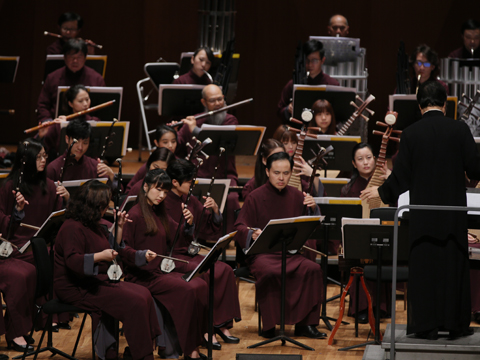
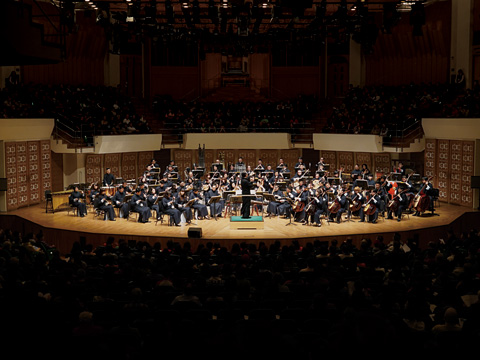
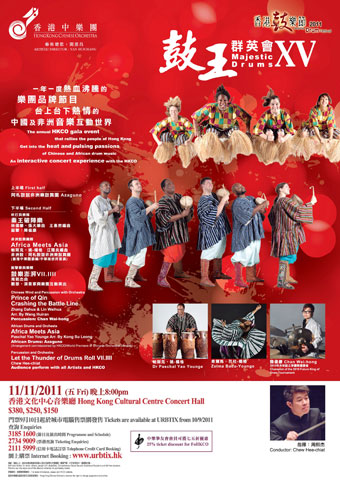
Such unique charm began to shine forth significantly on the international music stage during the turn of the 21st Century. Apart from continuing to enrich the rhythm of popular music, the genre has also become a topic for research at academic institutions, and it has been taken up in music education for young children as a key to the music world. At the same time, in the arena of professional classical music composition, African drum music has come into much greater collaboration through more compositions that present it in mainstream performance settings, for example the string quartet, the symphonic orchestra, and even a Chinese orchestra, as exemplified by this concert being presented by the Hong Kong Chinese Orchestra. In most of these African drum music works that have entered the international stage, we still find that its original, unique charm has been adequately preserved, a charm that will invite the listener to return to the expansiveness of the unspoiled African continent and the origin of human life, to revisit the beauty of human traditions …..