Conjugal Love and Patriotic Love: On Butterfly Lovers and Yellow River
Chow Fan-fu
The string concerto Butterfly Lovers and the Yellow River chorus and piano concerto have for a long time been popular concert repertoires. But prior to the 1980’s, the colonial British government of Hong Kong did not encourage the performance of these two works, and chances of their being performed at the Hong Kong City Hall were rare. Although later the restriction was relaxed, the last movements of the Yellow River Concerto, titled The East Is Red and L’Internationale, had to be omitted. This is obviously the result of the colonial government’s reluctance to see national sentiments being stirred up by the music.
Romantic Love and Patriotism Expressed in Music of Distinctly Different MoodsThe Butterfly Lovers deals with love between a man and a woman, and the Yellow River is about one’s love for the country. It may be cursorily concluded that they represent the distinctly different moods of the tender and the robust, whether in terms of programme contents, themes, styles and spirits. But if we look closer at the history of the works being performed, we may find something interestingly related to national feelings, and that provides the link between the two.
The Yellow River Concerto sings in praise of an important moment in contemporary history, when the whole of China joined in one to fight against Japanese aggression and the triumph in the end. The national spirit and national pride are captured in the music. The melodies and lyrics used are essentially Chinese, showing the Chinese elements which inform its basis and the western compositional techniques used. The music is magnificent, in which a long existent sense of oppression finally comes to be liberated. This is why the Yellow River can create such emotional upsurges among the Chinese, and why it has never lost its popularity.
Butterfly Lovers has its own unique appeal and it expresses the great and incorruptible love between a man and a woman. However, oftentimes a performance of this work, like the Yellow River, is tinted with political overtones, and is interpreted as an expression of certain feelings for the nation. In point of fact, the Butterfly Lovers Concerto was written as a tribute to the nation upon the tenth anniversary of the founding of the People’s Republic of China, and its political origin is therefore obvious. So, what are the emotional contents that inform the Butterfly Lovers Concerto?
It is a very female-oriented work and the performers are mostly female, too
The Butterfly Lovers Concerto, following the storyline established in the folklore that gives the work its title, places much greater emphasis on Zhu Yingtai, the heroine, rather than Liang Shanbo, the hero. It dwells considerably more on the internal turmoil of Zhu caused by the meeting and separation of the two, and the music sounds like the narration of their story by a third party, with a highly prominent inclination towards the female. It is also a fact that, the most popular recordings of the work made before the 1990’s were almost all played by female violinists. On the Mainland, there were recordings by Yu Lina, Shen Rong, Tang Baoti, and Dou Junyi, whereas outside China, there was the version played by Takako Nishizaki, a Japanese national based in Hong Kong. More from Hong Kong were versions featuring male violinists such as Lim Kek-cheong, Lau Yuen-sang and Lim Kek-han, but their recordings do not nearly sell as well as the ladies’, or can they compare in popularity.
There is a reason behind the popularity of the “female” recordings of the Butterfly Lovers Concerto. He Zhanhao has made it quite plain that to perform the work well, the emphasis must be placed on “love”. In the composer's opinion, the player has to understand three points:
First, the Butterfly Lovers is profoundly dramatic, rather than ordinarily lyrical. It requires nothing less than strong passions in order to render the joy and grief in the heart of Zhu Yingtai, and it must also be the strong passions professed by women of the ancient times. The second point is that the fast pentatonic passages are technically very demanding, and require a high degree of virtuosity from the player. Lastly, the piece is built upon elements drawn from Yue Opera, and its performance requires a representation of the flavours of the scenic region of South of the Yangtze, and so a feeling for the place is necessary apart from feeling for the human figures.
The Chinese Orchestral Version that Changed the Fate of Butterfly Lovers
As said, the emphasis of Butterfly Lovers is on the depiction of the feelings of the heroine, Zhu Yingtai. It is, therefore, deemed to be more appropriate for a female performer to express the emotional nuances inherent in the work. However, it is still a tall order to meet the three requirements set by He Zhanhao.
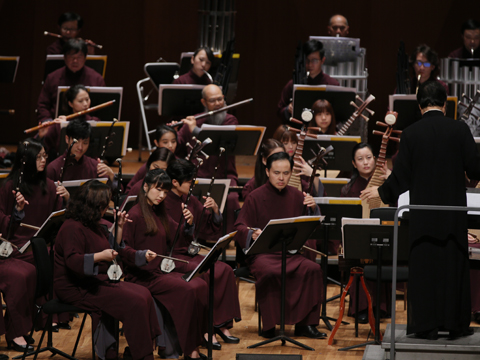
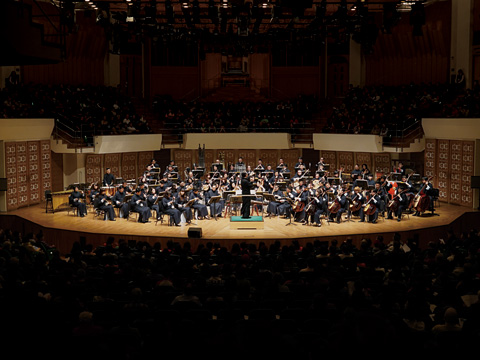
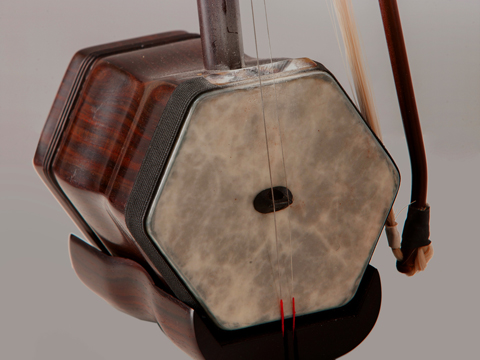
On the other hand, the version of the Butterfly Lovers as adapted for the gaohu and the Chinese orchestra has become immensely popular. It would appear that, through the Chinese instruments, the gist of the work could be more effectively expressed than through the original western instrumentation, and that the regional and nationalistic sentiments of the piece may be explored more fully. When the Hong Kong Chinese Orchestra visited Taiwan in 1988, it brought with it the gaohu version. At that time, the violin version was still banned in Taiwan, despite the fact that it had its fair share of clandestine fans among music lovers there. It was the first time that the work was performed in Taipei’s National Concert Hall. On the opening night of the Hong Kong Chinese Orchestra’s orchestra, Chiang Wei-Kuok, the brother of President Chiang Ching-Kuok, was in the audience. Such tacit endorsement led to the lifting of the ban on the work in Taiwan, and the subsequent extreme popularity of the piece. This would appear that the performance had not only explored the conjugal love in the Butterfly Lovers, but also evoked national and nationalistic sentiments as a spin-off.
An Emotional Complex for the 20th Century Chinese
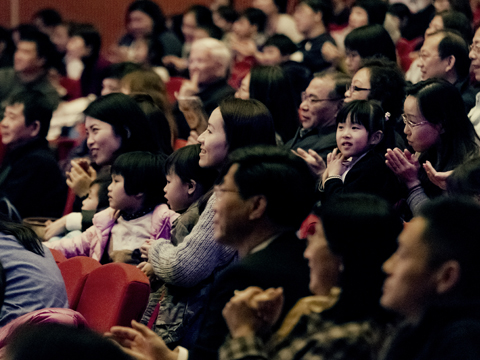
Those were the days when any performance of the Butterfly Lovers and the Yellow River in Hong Kong, Taiwan, the United States and Canada, would attract crowds - whatever version was being played, whoever the conductor, soloist or singer, whichever orchestra and chorus, and be it the Chinese or western version.
The attraction comes from the feelings that are inherent in the works. While it is accepted that both the Butterfly Lovers and the Yellow River are western in terms of compositional techniques, there can be no denying that a lot of ethnic elements have been incorporated. Some of the techniques involved may perhaps be criticised for being conservative or immature, but they are still effective in expressing the national sentiments and spirits of the Chinese people. While such expressions tend to be much more intense in traditional opera, folksongs and narrative singing genres, the modern audience seems to be fonder of the Butterfly Lovers and the Yellow River, which are both “dressed up in western costume”. If we probe into the reasons behind, then we will discover that this has a lot to do with the psychological complex that many Chinese people had not too long ago with regard to their national destiny.
Since the Qing Dynasty, and especially since the last of the dynastic days, China had a long period of weaknesses. A national lack of self-esteem had developed over the past century, and it is not easy for such sentiments to be wiped away quickly. Mainland China had been on its way to modernisation and reforms, and rapid economic growth since the 1980’s, but wealth and prosperity are still some distance away for the entire country. There is an inevitable mixture of love-and-hate attitudes towards the materialism and culture of the West, and there is a continued practice of “nationalizing” western arts and culture and adapting them for Chinese use. Both works are good examples of this attitude and practice, and satisfy the complex which demands that one cannot accept and adopt Western music in a wholesale manner.
Music has, for a long time, been used as a tool whereby the listener may project his own sentiments. Many are the hardships and vicissitudes that the Chinese people suffered in the 20th Century, and the older generations can never free their minds from memories of sufferings of the past. Those who are young and who have the good fortune of having grown up overseas, on the other hand, have little or no sense of identity with their own nation and its people. There were changes in the 1980’s when Hong Kong was about to be returned to the mother country, and the many emotional strands that permeate the Butterfly Lovers and the Yellow River would just meet the needs of the local people, each taking what he or she holds to be valuable. It can be said that the Butterfly Lovers has become part of the collective memory of many Hong Kong people as they grew up, and that explains why the work enjoys popularity among the old and the young. It satisfies the emotional needs of so many people so well, and echoes what they have in their minds. It is much more than the satisfaction that the appreciation of music can bring.