
HKCO
Hong Kong Chinese Orchestra Environmental, Social and Governance Artistic Director and Principal Conductor for Life Orchestra Members Council Advisors & Artistic Advisors Council Members Management Team Vacancy Contact Us (Tel: 3185 1600)
Concerts
Education
The HKCO Orchestral Academy Hong Kong Youth Zheng Ensemble Hong Kong Young Chinese Orchestra Music Courses Chinese Music Conducting 賽馬會中國音樂教育及推廣計劃 Chinese Music Talent Training Scheme HKJC Chinese Music 360 The International Drum Graded Exam
Instrument R&D
Eco-Huqins Chinese Instruments Standard Orchestra Instrument Range Chart and Page Format of the Full Score Configuration of the Orchestra
13
July 2012
A Sedan Chair for the Bride
The Wonderful Winds of Guo Yazhi II
Date and Time
13-14/7/2012
8:00 pm
8:00 pm
Venue
Hong Kong Cultural Centre Concert Hall
Ticket Fee
$300, $250, $150
Conductor
Yan Huichang
Performed by
Guo Yazhi
Programme
The Wedding Song Shandong Folk Music Arr. by Ren Tongxiang
Suona: Guo Yazhi Sheng: Cheng Tak-wai, Lu Yi
Chinese Wind and Percussion Ensemble A Toasting Song of Joy
Wang Gaolin
Suona: Liu Hai, Law Hang-leung
Suona and Percussion Soar Ng Cheuk-yiu
Suona: Guo Yazhi
Chinese Wind and Percussion Ensemble
Birds Paying Homage to the Phoenix Shandong Folk music
Suona Concerto Ecstasy of Nature
(20th Century Chinese Classic) Zhu Jianer
Suona: Guo Yazhi, Xia Boyan, Law Hang-leung
Instrumental Trio One Night in Beijing Arr. by Ngai Kwun-wa
Suona: Guo Yazhi Pipa: Zhang Ying Jinghu: Ngai Kwun-wa
Take Five – Capriccio for saxophone, huqin and Chinese orchestra
Dave Brubeck
Arr. by Yard Guo and Guo Yazhi Orch. by Yard Guo
Gaohu: Zhang Yuhui Erhu: Lu Yunxia, Xu Hui Zhonghu: Mao Qinghua
Going to Meet the Bride Henan Folk Tune Arr. by Zhang Yibing
Performance - The Bridal Sedan: Jinzhong Municipal School of Arts, Shanxi
Suona: Guo Yazhi Sheng: Cheng Tak-wai, Lu Yi
Chinese Wind and Percussion Ensemble A Toasting Song of Joy
Wang Gaolin
Suona: Liu Hai, Law Hang-leung
Suona and Percussion Soar Ng Cheuk-yiu
Suona: Guo Yazhi
Chinese Wind and Percussion Ensemble
Birds Paying Homage to the Phoenix Shandong Folk music
Suona Concerto Ecstasy of Nature
(20th Century Chinese Classic) Zhu Jianer
Suona: Guo Yazhi, Xia Boyan, Law Hang-leung
Instrumental Trio One Night in Beijing Arr. by Ngai Kwun-wa
Suona: Guo Yazhi Pipa: Zhang Ying Jinghu: Ngai Kwun-wa
Take Five – Capriccio for saxophone, huqin and Chinese orchestra
Dave Brubeck
Arr. by Yard Guo and Guo Yazhi Orch. by Yard Guo
Gaohu: Zhang Yuhui Erhu: Lu Yunxia, Xu Hui Zhonghu: Mao Qinghua
Going to Meet the Bride Henan Folk Tune Arr. by Zhang Yibing
Performance - The Bridal Sedan: Jinzhong Municipal School of Arts, Shanxi
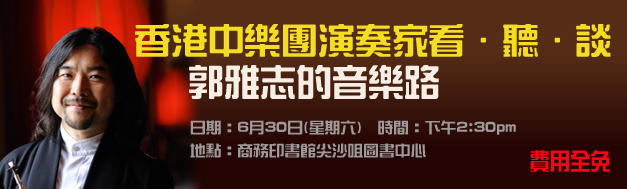
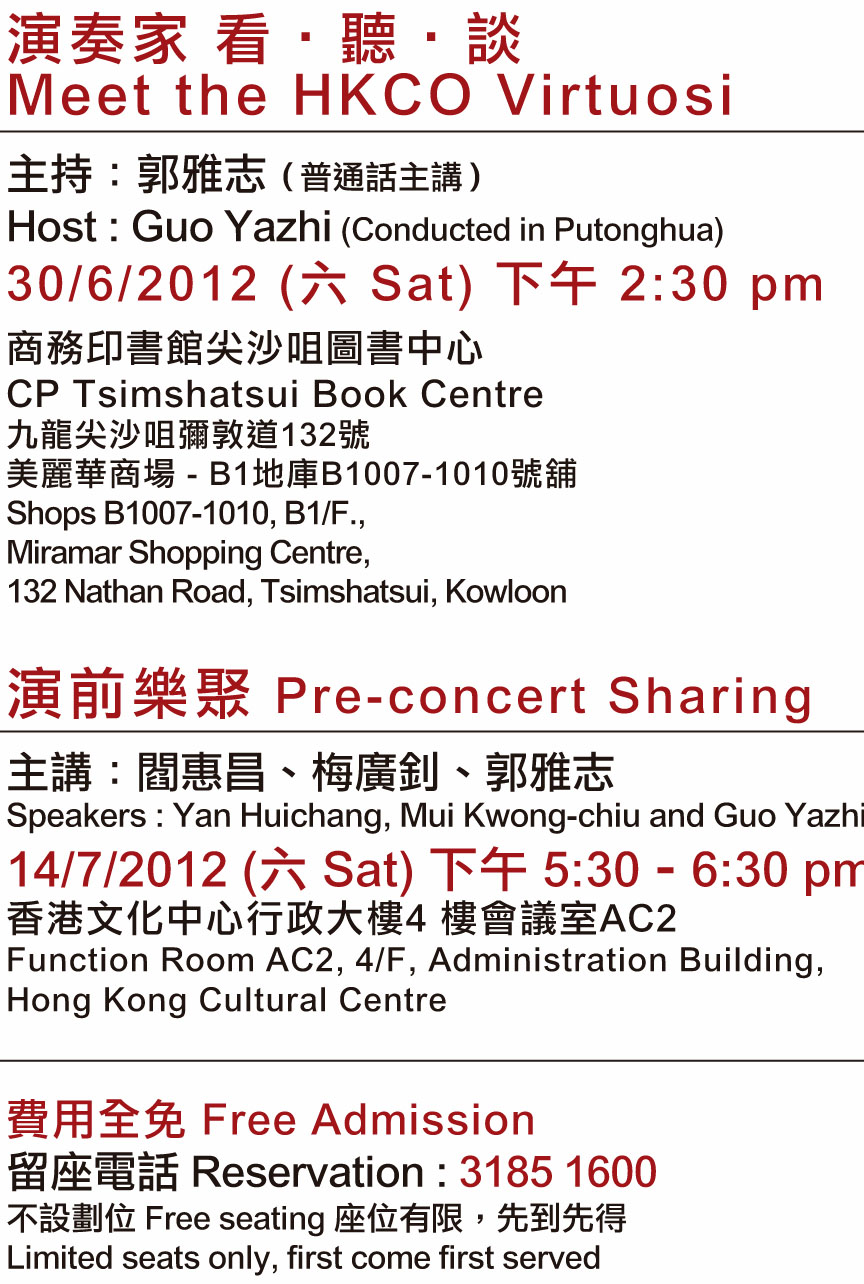
Meet the HKCO Virtuosi
Music: Views and Previews
The Artistic Hallmark of Guo Yazhi’s Suona
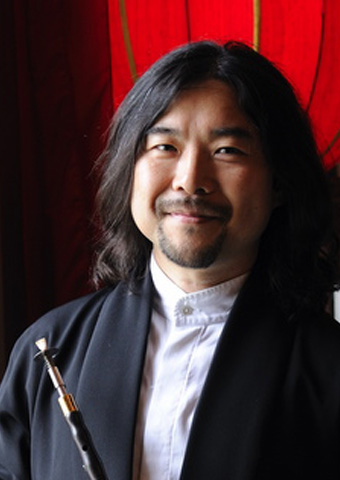
Chow Fan-fuIn addition to revolutionizing the traditional image of the suona, Guo Yazhi has taken the artistry of suona music to a whole new dimension with his amazing virtuosity. Guo’s suona is, paradoxically, both traditional and contemporary. In a reprised concert with the Hong Kong Chinese Orchestra, A Sedan Chair for the Bride – The Wonderful Winds of Guo Yazhi II, Guo stamped his mark on the form, style, expressions and colour of suona music.
The suona is one of the most important instruments in Chinese folk music. According to archives, the suona originated from Persia, and was a wind instrument widely used by common folks in China since the Ming and Qing periods in the 16th Century. The suona consists of a conical wooden body; at the top end is a brass bocal with a reed affixed, while the lower end is fitted with a flared metal bell (or bowl). The suona is sometimes also referred to as the laba in China. (Elsewhere it is called variously shawm, zurna or sorna.) In general, the traditional suona has a range of seventeen diatonic degrees. Its most distinctive characteristic is that volume, pitch and timbreare controlled by the mouth. The difficulty in executing accurate pitch control [at semitone], the many playing techniques, its shrill and strident timbre, and its robust expressiveness all make it technically challenging. The traditional suona is often featured in Chinese operas, folk songs and dances, rituals and festivals, as well as local celebrative activities.
The traditional image of the suona has, in fact, been one of rusticity. Its association with festivity, funerals and religious processions is more pronounced than with traditional Chinese theatre. Theinstrument is invariably involved in both joyous celebration and mournful sadness. Indeed, in real life society the suona has traditionally played an unpretentious, unrefined, rural and peasant role. Having said that, the suona is a difficult instrument to learn and master. True suona maestros are few and far between. Most folk artists can only “indulge” the unbridled nature of the suona, resulting in the production of mostly sharp, exaggerated and even discordant sounds.
The breakthrough in Guo Yazhi’s suona playing is in his successful incorporation of the hues and sensations of cosmopolitan modernity into his music, even when he plays a traditional folk piece. Whether it is his management of chromatic and melodic variations or his rhythm in breathing, Guo is able to eliminate the traditional flavours of coarseness, cacophony, gaucherie and parochialism from his suona music. Being able to infuse a sense of gentle calm into the suona’s inherent strident personality is no mean feat. Guo’s mastery of such a skill, his success in transforming the image of the suona and his development of a unique artistic hallmark in suona music are undoubtedly related to his proficiency with several Western and Chinese wind instruments (such as the saxophone, shuangguan, xun and guanzi) and his invention of the removable reed for the suona. However, it is not difficult to discern from Guo’s journey to musical success that, apart from his technical expertise, the other very significant contributory factor to his unique achievement is his keen perception of music, of cities and of life itself.
Guo Yazhi’s musical odyssey began in the Jinzhong Art School in Shanxi Province. From there he later moved on to Beijing and immersed in its rich Chinese culture. The next port of call was New York, the world’s artistic melting pot, where Guo experienced the stimuli of differing cultures. He then joined the Hong Kong Chinese Orchestra, under whose auspices Guo toured the world’s major cities. With Hong Kong’s brand of East-West fusion culture as the base, this stint helped Guo to broaden his horizon, nurture his intellect, and hone his perception of music. This was the keystone of Guo’s ability to urbanize and contemporize suona music, and to integrate the sense and colour of modern urbanism into his own unique style of suona artistry.
The works selected for the coming A Sedan Chair for the Bride – The Wonderful Winds of Guo Yazhi II concert consist of both traditional folk music and original compositions from modern composers. Some of the pieces are performed with the orchestra, while others are accompaniments to pop singers. Apart from the suona, the instruments featured in the concert include the saxophone, the guanzi, the paixiao and so on, all of which demonstrate Guo’s versatility with wind instruments. And particularly with the suona, the special treat is the brilliant chromatic display brought by Guo’s unique blend of the traditional with the modern.