The ‘Male Lead’ in the Chinese Orchestra
Chow Fan-fu
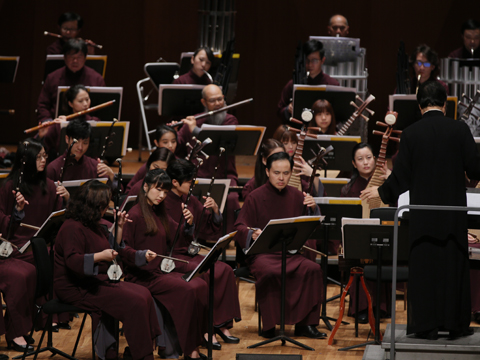
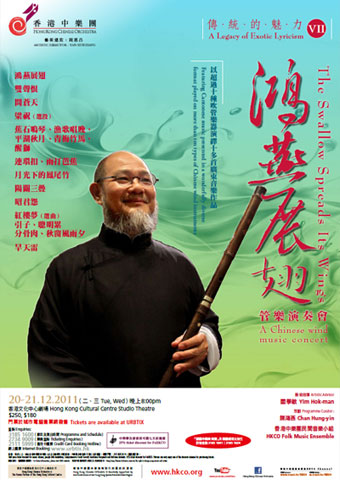
“The Swallow Spreads Its Wings” is a wind concert of the Hong Kong Chinese Orchestra featuring Chan Hung-yin, a seasoned player with the orchestra, in the lead. Chan will make use of over ten types of wind instruments to meet the varied demands of different works, and each of the wind instruments featured also has its own distinguished characteristics. The matching of them, therefore, becomes of prime importance.
Each instrument in the extensive wind family of the Chinese orchestra carries its uniqueness. However, it is still very common for people to mix up the xiao (Chinese flute, also called dongxiao) and the di (also called dizi), the two major wind families. At this concert, Chan Hung-yin will play three xiaos (the Cantonese xiao, the nanxiao and the qinxiao) and six dis (the bangdi, the qudi, the dadi, the bass dadi, the paidi and the xindi). The most obvious distinction between the two is that the di is played horizontally, while the xiao is played vertically. Also, there is a membraned hole on the di (with the exception of the xindi), while the xiao does not have a membraned hole, but a rear sound hole. Since the dis mostly come with a membrane, it can be generalized that the instrument is sounded through resonance of the bamboo tube that is the di itself, and to this is added the oscillations of the membrane. As a result the di has a sharp, clear and brilliant sound of immense penetrating power, making it the ‘male lead’ in a Chinese orchestra.
A further explanation is that most instruments in the di family are treble or soprano instruments, and it is so even among the so-called bass version, the dadi. Let us take the commonly used instrument in G as an example: we will find its range similar to that of the transverse flute in the West, the lowest note being the D above the middle C and so rightly a treble instrument. The qudi is generally regarded as the alto di. Taking the commonly used D model as an example, the lowest note is the A on the second space of the treble stave. The commonly used G model of the bangdi is even closer to the Western piccolo, with its lowest note three notes higher than that of the qudi in D. Selected for solo performance in the present concert is a paidi (in the concept of a panpipe in Western music) made up of the C minor di (the other di which together forms the paidi is a qudi in C). This combined instrument has a range even higher than that of the bangdi in G and is certainly a soprano instrument.
Because of its many characteristics the di has a colourful and sharp profile all its own. Like the male lead in opera, it takes all the attention whenever it appears. It is not possible for it to play the middle notes in harmony, nor does it complement other instruments with ease. (What can blend well with it is the sheng, which is well-known for its enormous capacity for integration with other instruments). For this reason the di family will depend very much on the tightness with which the membrane is attached to these instruments, the performance techniques employed, and the suppression of the di’s dominating nature as the male principal, if they are to function well in large-scale ensemble work, or in an accompanying capacity. In theatrical terms, this is likened to taking a supporting role.
Whether the di instruments are acting ‘in character’ as the male lead, or suppressing their dominant character to assume a supporting role, the treble and soprano di instruments are extremely difficult to deal with. The reason is that the higher the pitch, the shorter and less controllable the tube for resonance. To this are added problems such as inconsistency in the specifications of the di itself and external climatic changes such as the impact of stage lights. These are all factors beyond prediction, and even the most seasoned player is not immune from occasional inaccuracies in pitch. We may say that the di, as an instrument, is like a superstar and very hard to be used well.
As a matter of fact, the di and xiao families have been enlarged and by now there is the addition of the bass oversized di and the bass oversized xiao, as well as a crumb-horn shaped alto di. So there are now additional instruments in the bass and alto ranges, but in order to better demonstrate the charm of the ‘male lead’ in the treble and soprano ranges, Chan puts away the mid- and lower-ranged members of the di family, and concentrates on the instruments in the upper ranges. From what we can see, the ‘male lead’ in this programme is not Chan Hung-yin himself after all!